Halley's Comet Debris Lights Up Georgia Sky in Orionid Meteor Shower Astrophoto
Astrophotographer Tim McCollum captured three Orionid meteors alongside Orion's deep sky objects on Oct. 21, as the annual shower approached its peak.
By News Media House Staff ·
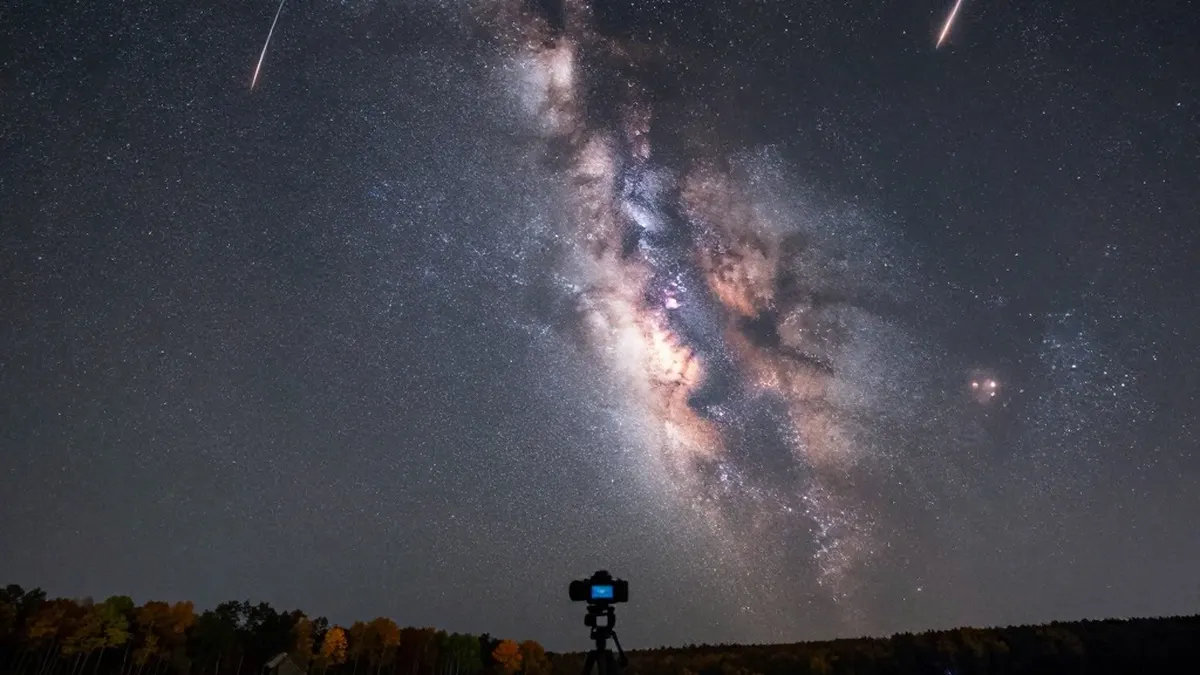
A striking astrophotograph taken earlier this week shows meteors from the Orionid shower streaking across a sky filled with deep sky objects. Astrophotographer Tim McCollum took the image on Oct. 21, as the annual display built toward its peak activity.
The meteors are debris shed by Comet 1P/Halley, also known as Halley's Comet. The comet is more than 3 billion miles from Earth at present, yet the particles it left behind still produced glowing trails in the autumn sky.
McCollum recorded three vivid Orionids above the city of Toccoa, Georgia, between 3 a.m. and 4 a.m. on Oct. 21. Each meteor appears to race away from the shower's radiant, the point from which the meteors seem to originate. That point lies near Betelgeuse, a red giant star in the constellation Orion.
Capturing a meteor on camera depends on skill, luck and patience. McCollum shot multiple 30-second exposures with a Canon EOS Ra camera and an RF 28-70 f2.0 lens. A star tracker kept the camera locked on the radiant throughout. The individual frames were then merged into one composite image with the astrophotography software PixInsight.
The frame holds more than meteors. The stars of Orion's Belt sit on the right side of the image, near the glow of the Orion Nebula, one of the nearest major star-forming regions to Earth. The Rosette Nebula, catalogued as Caldwell 49, is also visible within the dense starfield and dust lanes of the Milky Way's galactic plane, which runs diagonally across the composite. Numerous star clusters can be picked out as well.
Skywatchers still have time to see the shower for themselves. The Orionids remain active until Nov. 7, so the coming nights offer further chances to spot a meteor from Halley's Comet.
There is a possible bonus for observers who are lucky. Earth is passing through debris streams left by Comet 2P/Encke, which produce the Taurid meteor shower, and that stream can bring the occasional Halloween Fireball.
Space.com invites readers who want to share their own astrophotography to send their photos, comments, name and location to spacephotos@space.com.
Source: Space.com